[Summer Kamikochi] The Complete Day Trip Guide|Access and Recommended Walking Routes, On-Site Report
Last updated: Aug. 31, 2026
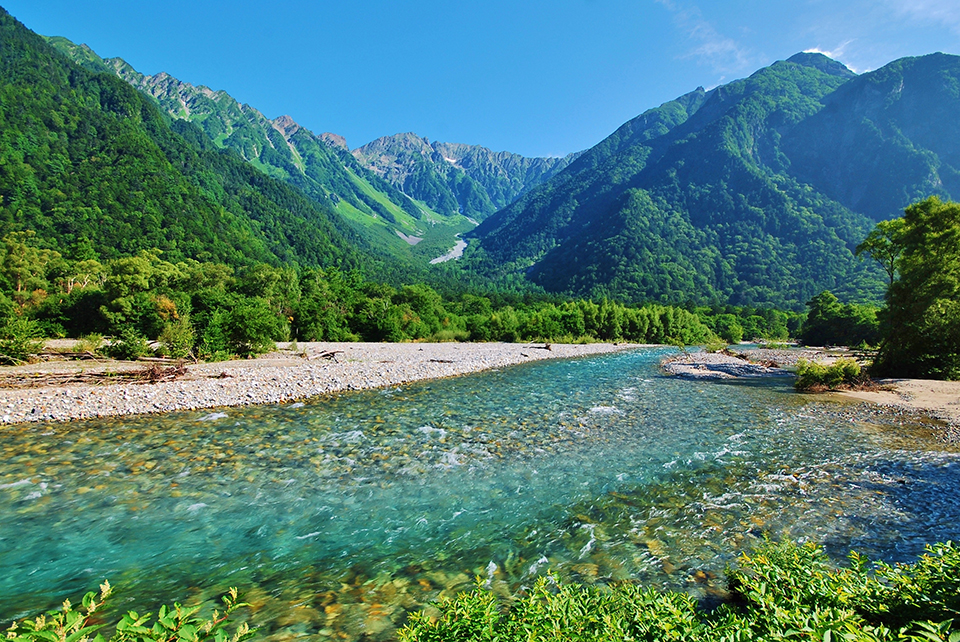
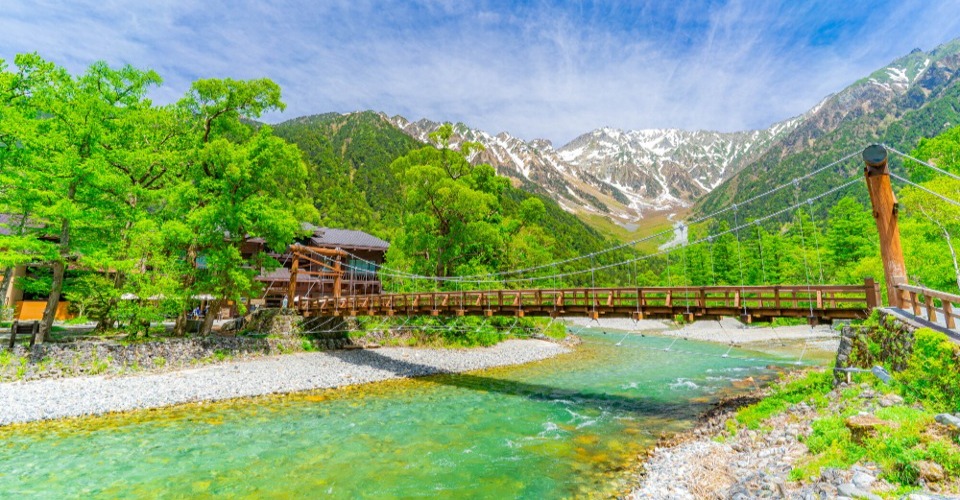
上高地・梓川(イメージ)
標高約1500mに位置し、雄大な山々と清らかな梓川が織りなす風景を楽しめる上高地は、言わずと知れた日本の避暑地です。東京や名古屋から日帰りで訪れることもできますが、限られた時間を有効に使うためには、アクセス方法やバスの乗り方、歩きたいルートをあらかじめ決めておくことが大切です。
今回は、一般社団法人松本市アルプス山岳郷の職員である多田さんの案内のもと、実際に夏の上高地を取材しました。現地でわかった情報も交えながら、日帰りで上高地を楽しむためのアクセス方法やおすすめの散策コース、服装などをご紹介します。
*This article was created for travelers planning to visit Japan, but readers in Japan may also find it useful.
-
Can you visit Kamikochi on a day trip? The travel and dwell times to know
-
The complete guide to reaching Kamikochi|What to watch out for
-
Walk Kamikochi in summer! A recommended day-trip model route
-
Choose by time and fitness! Walking routes in Kamikochi
-
What to wear in Kamikochi in summer? What to bring, and the facilities on site
-
Day trip or overnight stay: which is better?
-
Cost and time compared: arranging it yourself vs. a day-trip tour
-
FAQ: summer day trips to Kamikochi
-
Summary: enjoy Kamikochi in summer on a day trip
Can you visit Kamikochi on a day trip? The travel and dwell times to know
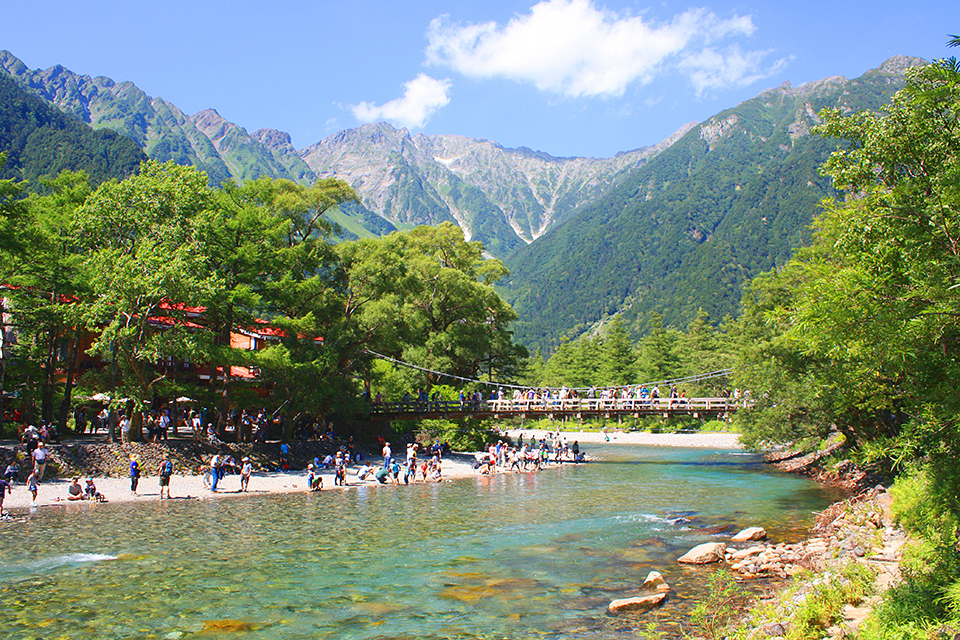
夏の上高地・河童橋(イメージ)
Kamikochi can be reached from Tokyo or Nagoya on a day trip using public transport. Getting there takes time, however, and involves changing between trains and buses along the way.
On a day trip in particular, think not only about how many hours it takes to reach Kamikochi, but also about how long you can actually spend there, working backwards from your return connection.
From Tokyo (Shinjuku)|A day trip using the Limited Express Azusa
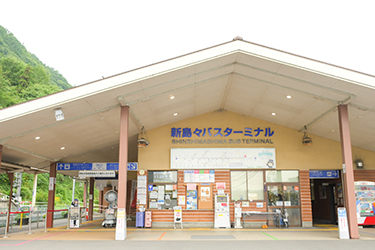
From Shinjuku Station, take the JR Limited Express Azusa to Matsumoto Station, then the Alpico Kotsu Kamikochi Line to Shin-Shimashima Station, and change there to a local bus for Kamikochi. This is the standard route.
Shinjuku Station to Matsumoto Station takes about 2 hours 40 minutes on the Limited Express Azusa; Matsumoto Station to Shin-Shimashima Station about 30 minutes by train; and Shin-Shimashima Station to Kamikochi about 1 hour by bus. Including connection times, allow at least four hours each way.
Sample timings (via Kamikochi Bus Terminal)
新宿駅(7:00発)→松本駅(9:38着/10:10発)→新島々駅(10:40着/10:50発)→上高地(11:55着)―――滞在時間:6時間―――上高地(17:55発※最終バス)→新島々駅(19:00着/19:25発)→松本駅(19:54着)
※特急あずさ、新島々駅から上高地間のバスは予約優先です
From Nagoya|A day trip on the Limited Express Hida via the Takayama route
From Nagoya you can either take the JR Limited Express Shinano via Matsumoto Station, or take the JR Limited Express Hida to Takayama Station, then a local bus from Takayama Nohi Bus Center to Hirayu Onsen, changing there to a bus for Kamikochi.
Nagoya Station to Takayama Station takes about 2 hours 40 minutes on the Limited Express Hida; Takayama Station (Takayama Nohi Bus Center) to Hirayu Onsen about 1 hour by bus; and Hirayu Onsen to Kamikochi about 25 minutes.
Sample timings (Limited Express Hida and Kamikochi Bus Terminal)
Nagoya Station (dep. 7:43) → Takayama Station and Takayama Nohi Bus Center (arr. 10:16 / dep. 10:40) → Hirayu Onsen (arr. 11:38 / dep. 12:00) → Kamikochi (arr. 12:25) ―――Time in Kamikochi: 4 hours 30 minutes――― Kamikochi (17:00) → Hirayu Onsen (arr. 17:25 / dep. 17:30, last bus) → Takayama Nohi Bus Center and Takayama Station (arr. 18:31 / dep. 18:48) → Nagoya Station (arr. 21:03)
*Buses between Takayama Station, Hirayu Onsen and Kamikochi are first-come, first-served and cannot be reserved
How many hours do you need for a day trip to Kamikochi?
It is about a five-minute walk from Kamikochi Bus Terminal to Kappa Bridge. If you only want to take in the scenery around the bridge, you can get a feel for Kamikochi in a fairly short time. Still, having come all this way, a walk along the Azusa River is worth the effort. The classic route from Taisho Pond to Kappa Bridge, for example, covers about 3.8 to 4.0 km and takes some 75 to 80 minutes. It is busy in season, so once you allow for photographs, souvenirs and a meal, you will want about 3.5 to 4 hours on site.
Later in this article we also introduce a recommended route around Kappa Bridge and the Myojin area that takes about 3 to 3.5 hours. Because it runs in the opposite direction from Taisho Pond when you start at Kappa Bridge, anyone who wants to see several parts of Kamikochi, or to take their time when there are fewer people about, may want to consider staying overnight in Kamikochi.
The complete guide to reaching Kamikochi|What to watch out for
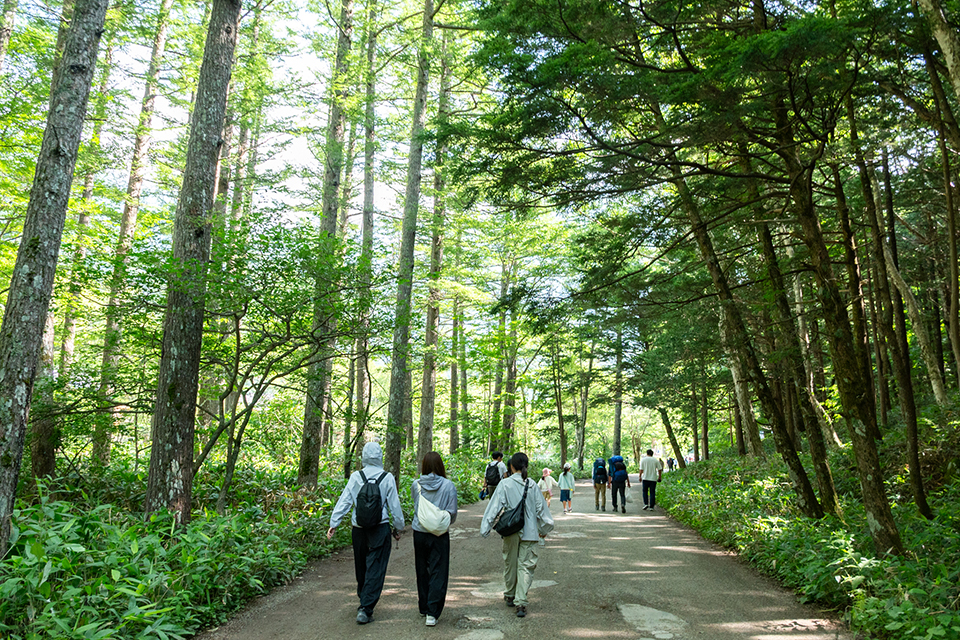
Private vehicles are restricted in Kamikochi
Many visitors want to tour Japan by rental car. In Kamikochi, however, private vehicles are restricted all year round to protect the natural environment, and rental cars and motorcycles cannot be driven directly into the valley.
Even if you come by car, you must park in the Sawando area if you are coming from Matsumoto, or at the Akandana Parking Lot in Hirayu if you are coming from Takayama, and then transfer to a shuttle bus or a taxi to reach Kamikochi.
From Matsumoto|Take the bus from Shin-Shimashima Station and check the booking method first
If you are heading to Kamikochi from Matsumoto by public transport, the usual route is to take the Alpico Kotsu Kamikochi Line from Matsumoto Station and change to a Kamikochi-bound bus at Shin-Shimashima Station.
For 2026, the Matsumoto and Shin-Shimashima–Kamikochi line gives priority to reservations, so those who have booked board first. You can still board without a reservation on a first-come, first-served basis if seats remain, but summer is busy, so booking online in advance is the safer option.
Do your shopping at Shin-Shimashima Station
If you are heading from Shin-Shimashima Station to Kamikochi, keep convenience stores in mind.
Past the convenience store near Shin-Shimashima Station, there are no convenience stores or ATMs all the way to Kamikochi. Kamikochi does have shops and places to eat, but if you need to buy supplies or withdraw cash, do it before you go any further.
[Important] Check your reservation and boarding point for the return bus!
Plan your return bus in advance as well.
Buses from Kamikochi toward Shin-Shimashima give priority to reservations, and you can board and book not only at Kamikochi Bus Terminal but also in front of the Imperial Hotel and at Taisho Pond. If you want a particular departure, book ahead.
One point deserves special attention: a great many passengers board at Kamikochi Bus Terminal, which is the first stop. If you try to board without a reservation at an intermediate stop such as Taisho Pond, the bus may already be full. Kamikochi Bus Terminal is especially crowded close to the last departure. Book ahead, and plan to be back at the terminal with time to spare.
New rules from September 2026
The boarding and alighting rules for return buses from Kamikochi to Shin-Shimashima changed on September 1, 2026. At the stops between Kamikochi and Sawando Ohashi you may board but not alight. The only stops where you can get off are Azumi Shisho-mae and Shin-Shimashima Station. If you have come by rental car from Sawando Bus Terminal, note that you cannot get off partway if you take a Shin-Shimashima-bound bus on the return leg.
Walk Kamikochi in summer! A recommended day-trip model route
From here, we introduce a route for enjoying Kamikochi in summer, recommended by Sorata Tada of the Matsumoto City Alps Mountain Village association. It runs from Kappa Bridge to the Myojin area, taking in Myojin Pond and Kamonji Hut before returning to Kappa Bridge, and takes roughly 3 to 3.5 hours including walking and breaks. Unlike the stretch from Taisho Pond to Kappa Bridge, it is relatively quiet, and the scenery shifts as you walk — the Azusa River and the Hotaka peaks, of course, but also marshland and primeval forest.
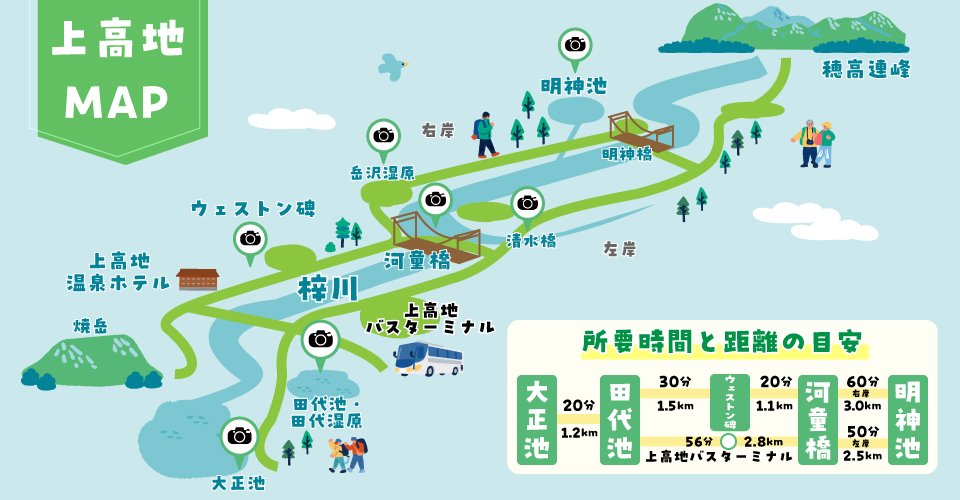
上高地マップ(イメージ)
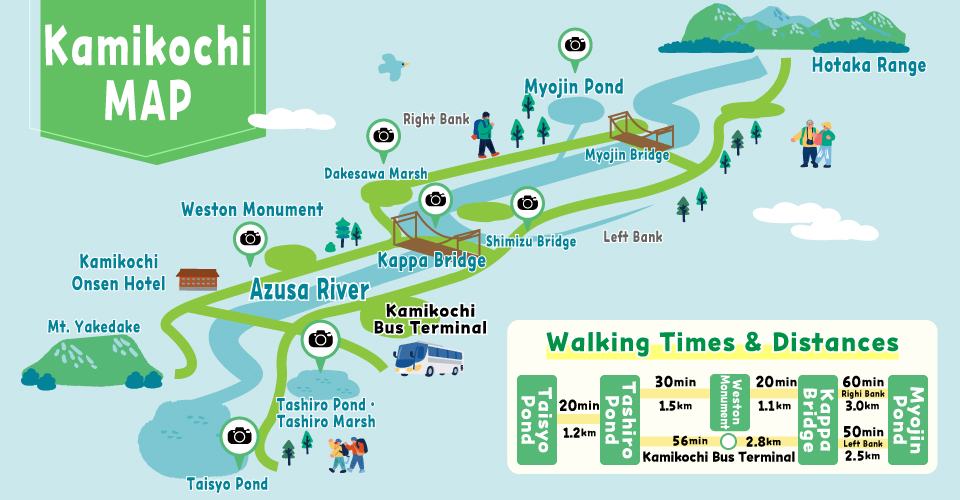
上高地マップ(イメージ)
① Kappa Bridge|Set off with a view of the Hotaka Range
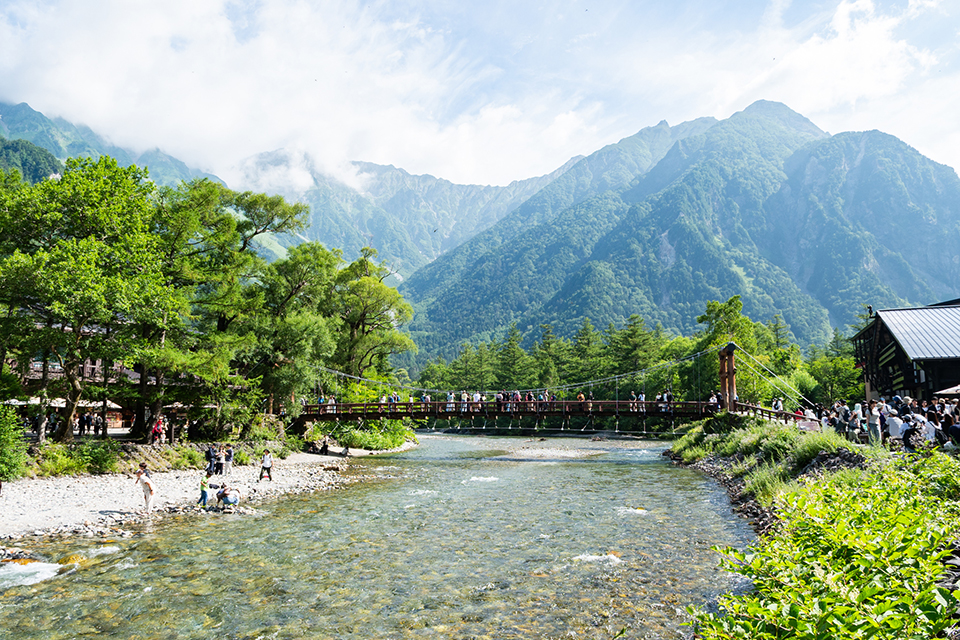
上高地・河童橋(イメージ)
Start about a five-minute walk from Kamikochi Bus Terminal at Kappa Bridge, the symbol of Kamikochi. From the bridge over the Azusa River you can see the Hotaka Range, and Mt. Yakedake on the opposite side. For photographs here, around 8:00 to 10:00 a.m. is best, when clear light falls on the peaks. Hotels, souvenir shops and restaurants cluster around Kappa Bridge, so it is busy with visitors. If you want to avoid the crowds and photograph a quiet scene, stay overnight in Kamikochi and come early in the morning. You can enjoy the clear morning air and a Kamikochi with far fewer people.
② From Kappa Bridge to Myojin|Walking through summer nature
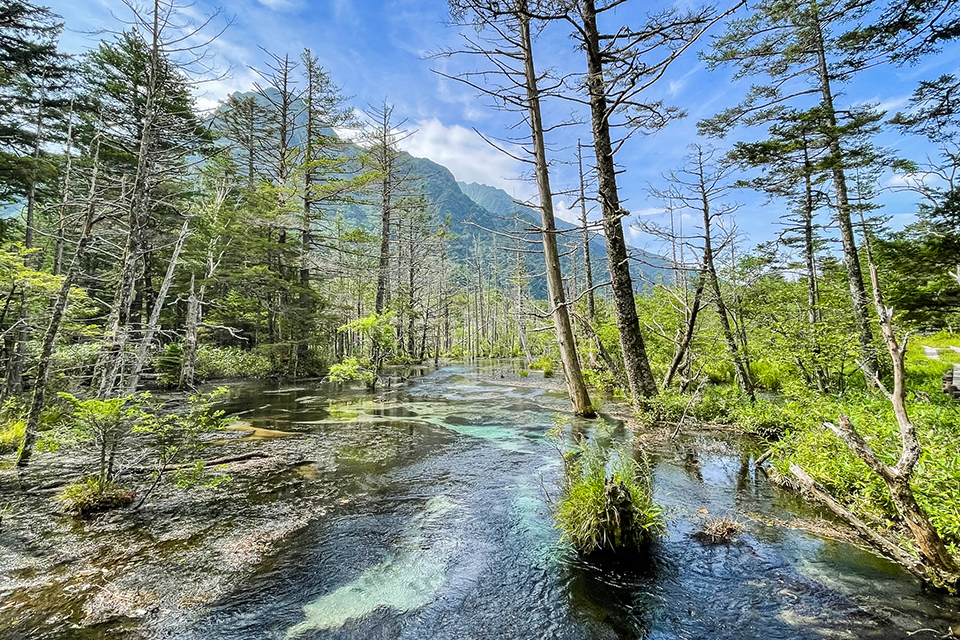
六百岳を望む岳沢湿原(イメージ)
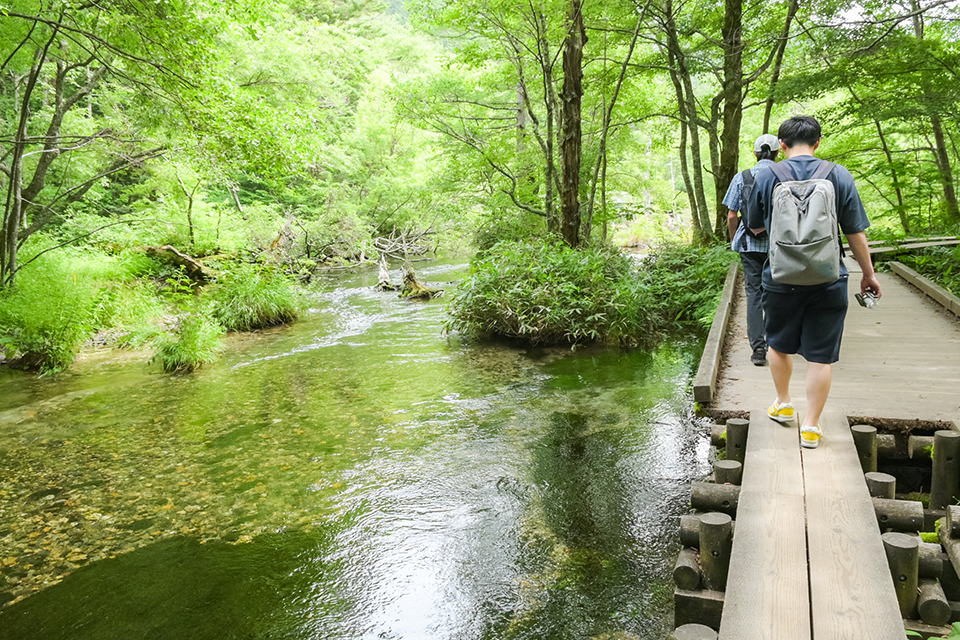
せせらぎを聴きながら木道を歩く(イメージ)
This time we head toward Myojin from Kappa Bridge along the trail on the right bank of the Azusa River. The right-bank route to Myojin takes about 60 minutes on foot and covers roughly 3.0 km. One place well worth a stop on the way is Dakesawa Marsh, some 15 to 20 minutes from Kappa Bridge. A boardwalk runs through primeval forest, and with its clear spring water, standing dead trees and Mt. Roppyakuzan rising beyond, it offers scenery quite different from the area around Kappa Bridge.
On a summer walk, look out for the flowers along the trail!
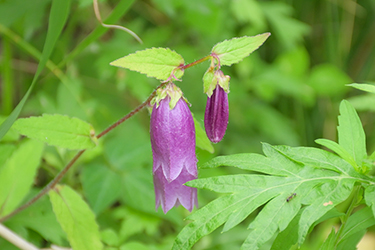
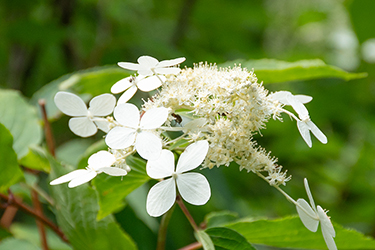
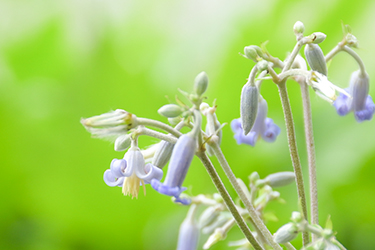
夏の上高地では緑の中に咲くさまざまな花にも注目です。今回の取材でも、散策路の各所で夏の花を撮影することができました。足元や木道の脇など、季節ごとに表情を変える自然も上高地散策の楽しみのひとつです。
③ Myojin Pond and Hotaka Shrine Okumiya|A mystical scene in the depths of a quiet forest
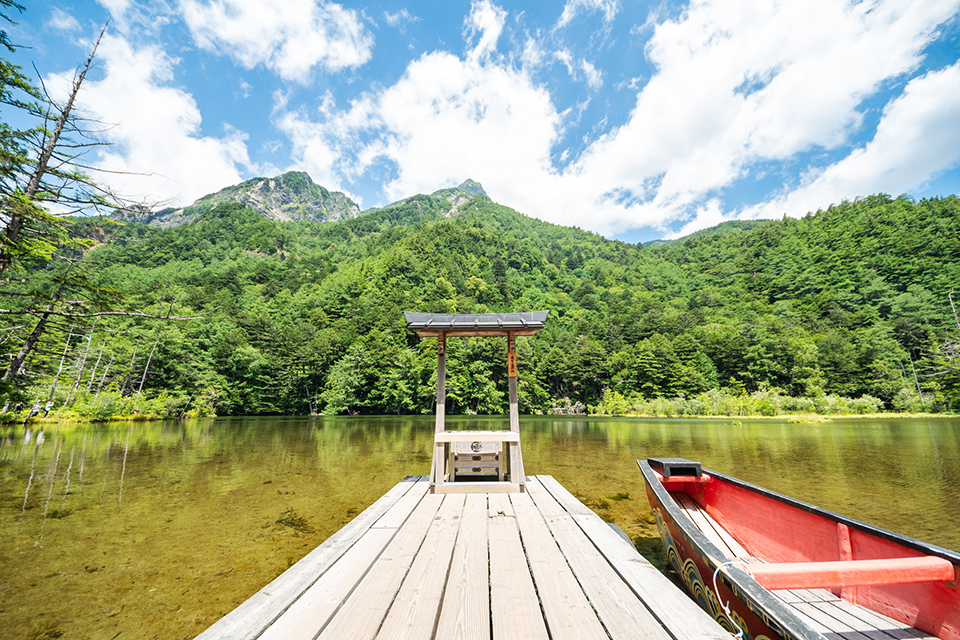
明神岳を望む明神池(イメージ)
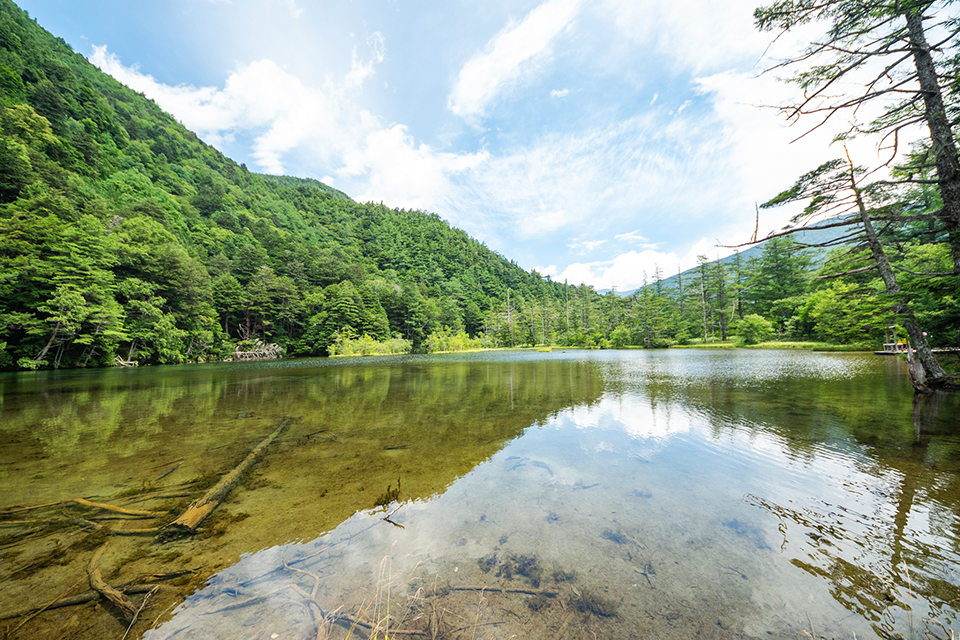
周囲の風景を反射する明神池(イメージ)
About an hour's walk from Kappa Bridge brings you to the Myojin area. Away from the bustle around Kappa Bridge, this is a quiet place enclosed by primeval forest, and it is home to Hotaka Shrine Okumiya and Myojin Pond. Set at the foot of Mt. Myojindake, Myojin Pond is a mysterious pool fed by underground streams and springs. When taking photos, try to frame not only the water but also Mt. Myojindake rising 2,931 meters behind it — a wide-angle camera or smartphone works well. As its old name "Mirror Pond" suggests, you can also catch a stunning reflection on a windless day.
*An admission fee is charged to visit Myojin Pond.
④ Kamonji Hut|Taste the house specialty: salt-grilled iwana char
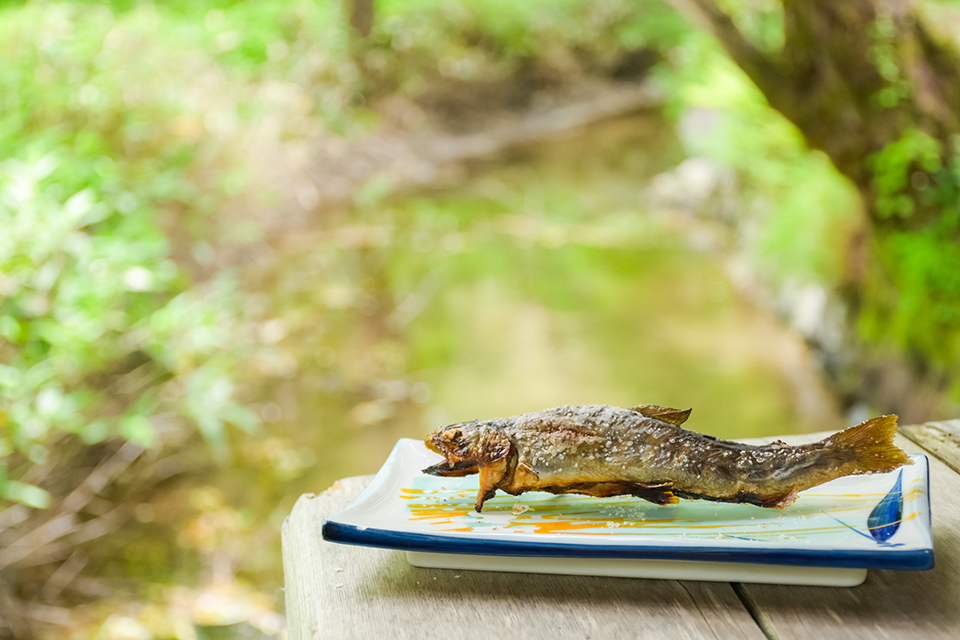
名物「岩魚の塩焼き」(イメージ)
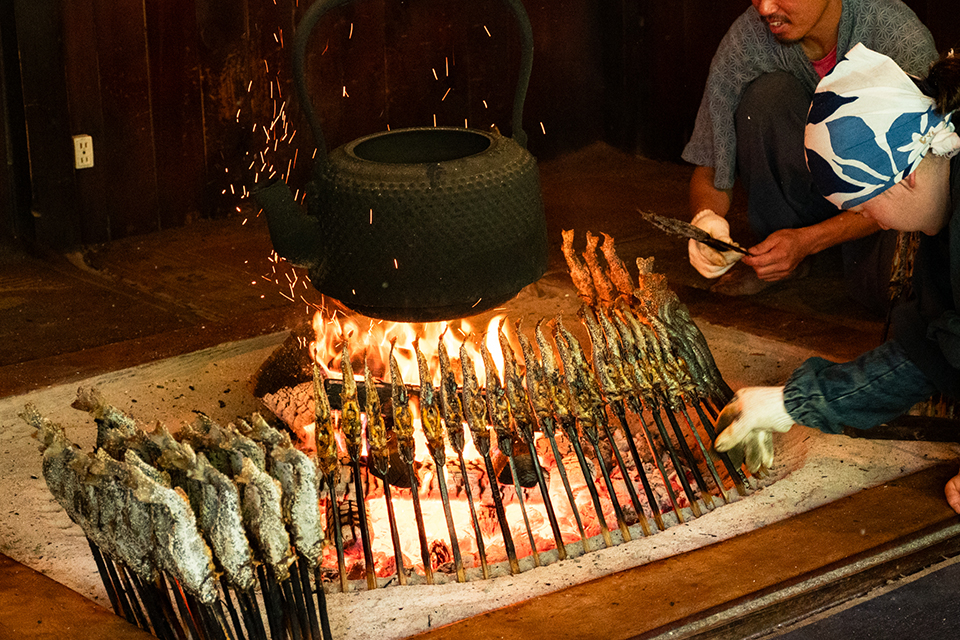
新鮮な岩魚を囲炉裏で焼く(イメージ)
開店直後から人が並び始める(イメージ)
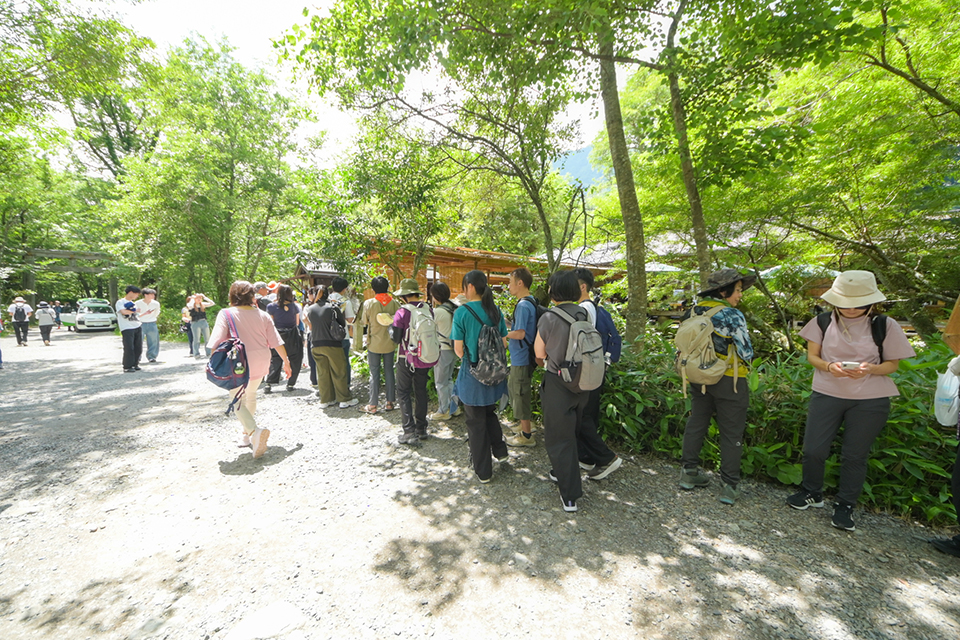
After visiting Myojin Pond, stop by Kamonji Hut just a short walk away. Founded in 1880, this historic mountain hut is known for its salt-grilled iwana char. The fish is taken straight from the holding tank and grilled slowly over a wood fire in the irori hearth — quite superb. You can watch the char being grilled over the traditional hearth, so the atmosphere is as much a part of the experience as the taste. The dining room opens at 10:00. On the day we visited, a line had already formed by 10:10 and we waited about 30 minutes for a seat.
*Crowd levels vary from day to day.
*Opening hours are subject to change.
*In summer you may not be able to enter the room with the hearth, and viewing may be from outside only.
⑤ Return from Myojin Bridge to Kappa Bridge for lunch and souvenirs
明神橋(イメージ)
明神橋近くの河原(イメージ)
左岸ルートにある風穴(イメージ)
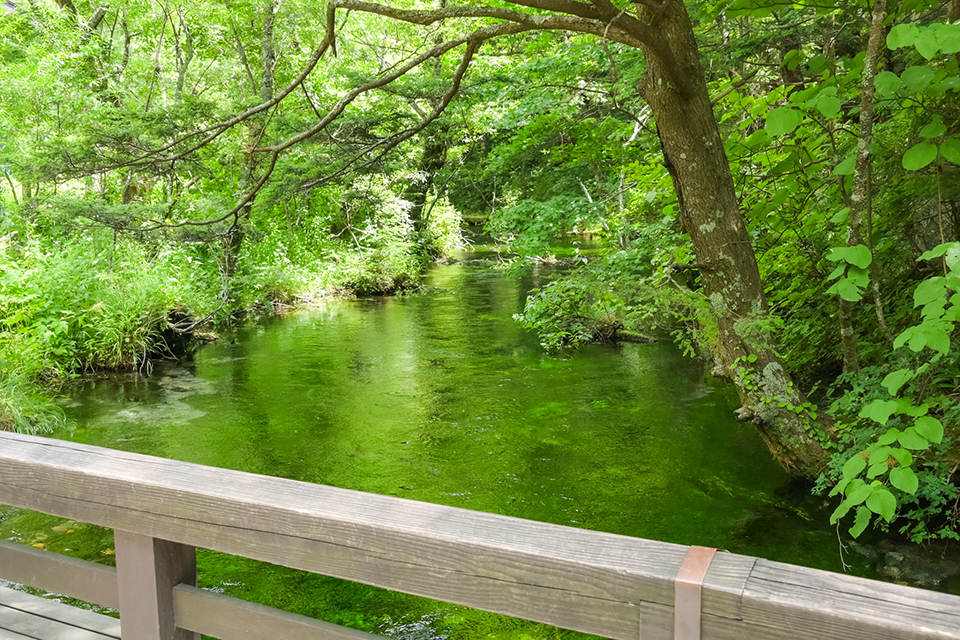
梅花藻の緑鮮やかな清水川(イメージ)
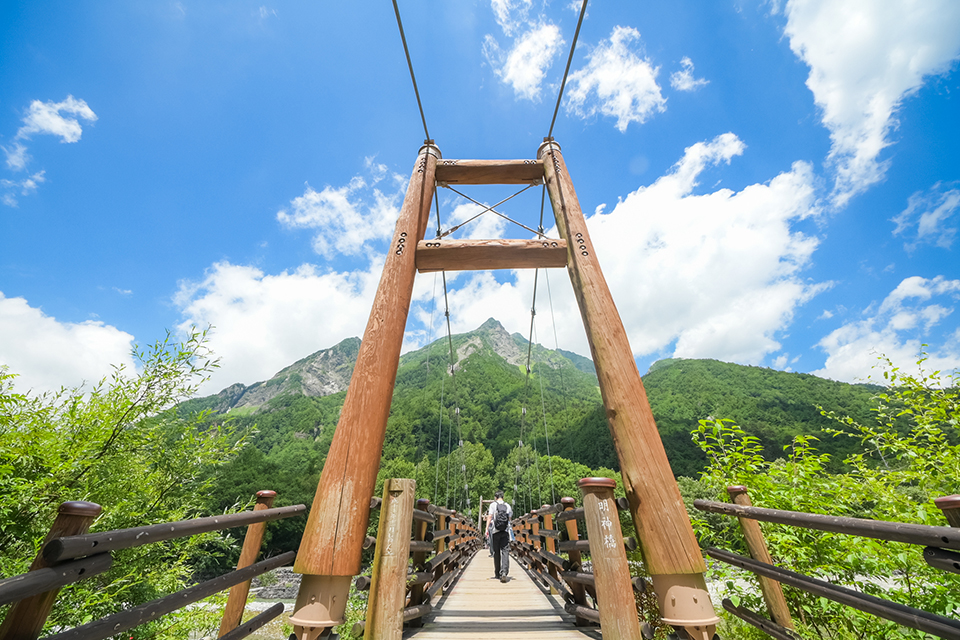
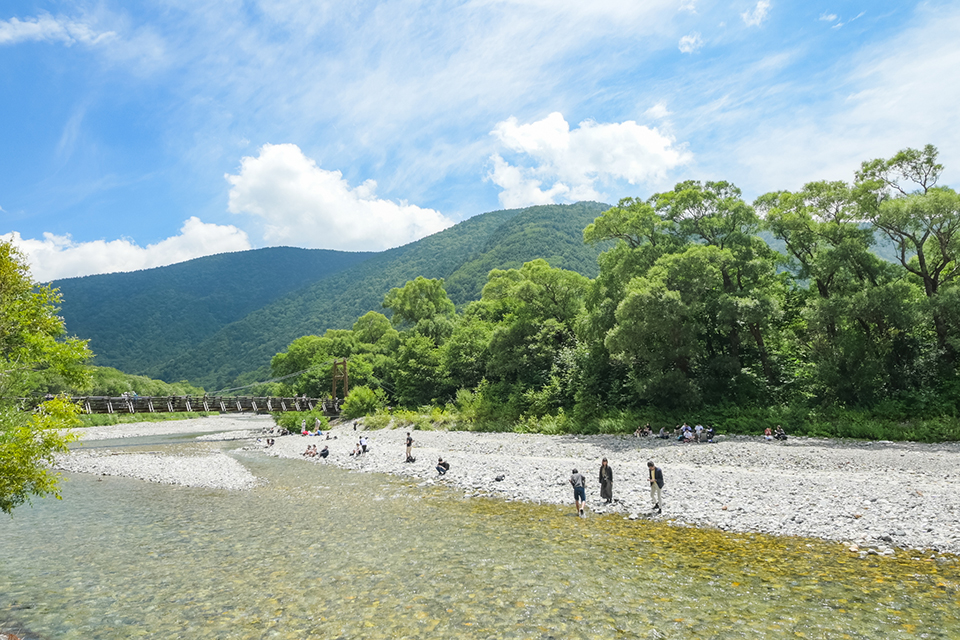
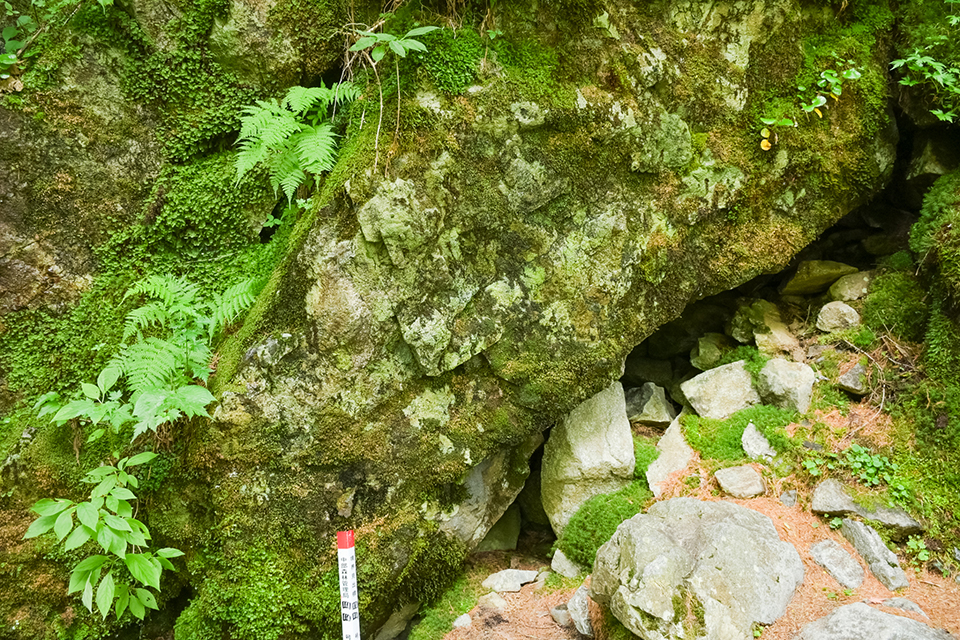
Once you have taken in the Myojin area, walk back along the Azusa River toward Kappa Bridge. Part of the appeal of this route is that you can take the trail on the opposite bank on the way back and see completely different scenery. Just after you set off, cross Myojin Bridge and turn around to photograph Mt. Myojindake and the bridge together. The left-bank route is largely flat, and along the way you can see the wind caves, where cold air streams out from gaps between the rocks, and Shimizu River, fed by abundant springs and full of beautiful aquatic plants.
Once you are back near Kappa Bridge, it is worth pausing at a cafe or browsing for souvenirs. Restaurants often have long lines at lunchtime, so allow plenty of time.
Choose by time and fitness! Walking routes in Kamikochi
Kamikochi offers many ways to walk, from short strolls to routes that take you deeper into the valley. Choose one that matches your time and your fitness.
| ルート | 所要時間の目安 | 距離の目安 | おすすめの人 |
|---|---|---|---|
| 大正池~河童橋 |
約75~80分 |
約3.8km~4.0km |
短時間で上高地らしい景色を楽しみたい人 |
| 河童橋~明神エリア往復 |
約1時間50分 |
約5.5km |
自然の中をしっかり散策したい人 |
*The estimated time is for walking only and may vary depending on your walking pace, breaks, and the places you stop at. If you plan to enjoy visiting Myojin Pond or having a meal at Kamonji Hut, please allow ample time in your schedule.
To avoid the crowds, try going "beyond Kappa Bridge"
In Kamikochi the stretch from Taisho Pond to Kappa Bridge tends to be the most crowded, and we were told that heading from Kappa Bridge toward Myojin Pond and on toward Tokusawa lets you walk in relative quiet. If you have the time and the energy, it is worth going beyond the Kappa Bridge area. A little away from the crowds, you can walk slowly and take in the forest and the Azusa River.
What to wear in Kamikochi in summer? What to bring, and the facilities on site
Cool mornings and evenings even in summer — layer your clothing
In July, average temperatures in Kamikochi are a high of 23.0°C and a low of 13.7°C (calculated from 2022 data published by the Kamikochi Visitor Center). Short sleeves will do during the day, but mornings and evenings can feel chilly, and even by day it can turn cold when it rains or the wind picks up. Pair a T-shirt or polo shirt with something you can put on and take off, such as a long-sleeved shirt. Bring a hat for the sun and comfortable walking shoes, and since mountain weather changes quickly, rain gear is a sensible addition.
Restrooms, payment, Wi-Fi and multilingual signage
●Public restrooms
Most operate on a tip basis. The money goes toward environmental conservation, so carry some coins.
●Payment
Many facilities accept credit cards and QR payments, but the admission fee for Myojin Pond and purchases at Kamonji Hut are cash only. There are no banks or ATMs in Kamikochi, so bring cash with you.
●Wi-Fi
Matsumoto_City_Free_Wi-Fi is available in the Kamikochi area.
●Luggage storage
There are no coin lockers in Kamikochi, but Kamikochi Bus Terminal has a staffed luggage room. The shelves can fill up at peak times, so leaving your bags at your accommodation, or on the coach if you are on a travel agency tour, is another option.
●Multilingual signage
English is generally provided, but traditional and simplified Chinese are comparatively rare. The information center near Kamikochi Bus Terminal also sells guidebooks in traditional and simplified Chinese.
Day trip or overnight stay: which is better?
If you simply want to see the classic views of Kamikochi and take a walk, a day trip is more than enough. If you would rather walk at your own pace without watching the clock, or experience a quiet Kamikochi quite unlike the daytime, staying overnight is worth considering.
The particular appeal of an overnight stay is having Kamikochi to yourself. Unlike the daytime bustle, you can see a sky full of stars at night and meet nature in the stillness of early morning — experiences only an overnight stay can offer. Time spent at one of Kamikochi's well-loved lodgings can be memorable in itself.
Cost and time compared: arranging it yourself vs. a day-trip tour
For a day trip to Kamikochi you have two options: independent travel, arranging your own trains and buses, or joining a tour run by a travel agency. They differ not only in cost but also in how long you can spend in Kamikochi, how many changes you make, and how much effort the arrangements take. Compare the two and choose what suits you.
Independent travel|More freedom, and a longer time on site
The great advantage of travelling independently is that you decide freely how to spend your time in Kamikochi. If you leave Tokyo early and allow enough time before the return bus, you can walk, eat and linger in cafes at your own pace. On the other hand, you have to check timetables and booking methods for the limited express trains and local buses yourself. The Matsumoto and Shin-Shimashima–Kamikochi line in particular gives priority to reservations, so if you have a departure in mind, book in advance.
〈Sample fares: Shinjuku departure via Matsumoto and Shin-Shimashima〉
| 区間 | 内訳 | 料金(大人・内訳) |
|---|---|---|
| 新宿→松本 |
特急あずさ運賃4,180円 |
6,730円 |
| 松本→新島々 |
アルピコ交通上高地線(鉄道) |
710円 |
| 新島々→上高地バスターミナル |
アルピコ交通 路線バス |
3,100円 |
|
片道合計 |
10,540円 |
|
|
往復合計 |
21,080円 |
You change trains and buses twice in total — at Matsumoto and at Shin-Shimashima — before reaching Kamikochi Bus Terminal. The outbound and return buses give priority to reservations, so booking online is recommended, and the Limited Express Azusa is often fully booked in high season, so a reserved seat is advisable.
*Based on information as of August 2026
The express bus option, and what to watch for on a day trip
The Sawayaka Shinshu-go express bus also runs from Shinjuku to Kamikochi with no changes along the way. On the 2026 timetable it leaves Busta Shinjuku at 7:15 and reaches Kamikochi Bus Terminal at 12:02, a journey of about 4 hours 50 minutes each way. Never having to change is a real advantage. On a day trip, however, watch the return departures. Buses leave Kamikochi at 14:30 and 15:50 daily, with an additional 16:50 departure on selected dates. If you arrive at 12:02 and leave at 15:50, for example, you have about 3 hours 50 minutes in Kamikochi.
Express buses can also be delayed by road conditions. Bearing in mind that congestion may cut your time on site, consider whether to prioritise having no changes, or to choose a rail-based route that makes your schedule easier to plan.
Travel agency tours|Less effort spent on transport and connections
〈Sample fares for the Club Tourism day-trip tour using the Limited Express Azusa (departing Shinjuku)〉
| 項目 | 内容 |
|---|---|
| 旅行代金 |
19,000円〜23,000円(時期により変動) |
| 交通手段 |
特急あずさ 指定席(往復)+ 松本〜上高地 観光バス(往復) |
| 上高地滞在時間 |
約4時間の自由散策 |
| 添乗員 |
同行あり |
Compared with independent travel, a travel agency tour has the advantage of taking the transport arrangements off your hands. This is exactly what Sorata Tada meant earlier in the article when he said that being able to drive straight in by coach is extremely convenient. Private vehicles are restricted in Kamikochi, but a tour coach can drive all the way in. On the Club Tourism tour compared here, you take a limited express from Tokyo to Matsumoto, then a sightseeing coach from Matsumoto into Kamikochi. Since you change only once, at Matsumoto, there is no local bus for you to book.
On time on site alone, arranging it yourself gives you the longest stay
As noted in the first half of this article, if you arrange the trip yourself and allow time up to the return service, you can spend around 6 hours in Kamikochi. The tour compared here allows about 4 hours on site, so independent travel wins on sheer free time. That said, on an independent trip you also have to arrange the return leg yourself, and the local buses back toward Shin-Shimashima likewise give priority to reservations. Choose according to what matters more to you: an independent trip that buys you more time on site, or a tour that shortens your stay but takes the transport arrangements off your hands.
The price difference is small
In this comparison, the round-trip fare comes to 21,080 yen if you arrange public transport yourself from Shinjuku. Club Tourism's day-trip tour, meanwhile, runs from 19,000 to 23,000 yen; the tour is cheaper on some dates, but there is no great difference in price.
The tour gives you less time in Kamikochi than an independent trip, but you do not have to book trains or buses yourself, and a coach takes you straight from Matsumoto into Kamikochi. Because a limited express covers the Tokyo–Matsumoto leg, less of the journey is exposed to road conditions than on an express bus. Price, time on site, ease of arrangement — compare each and choose on whichever matters most to you.
Three problems a tour solves
① You do not have to book the bus yourself
On an independent trip, the local buses on the Matsumoto and Shin-Shimashima–Kamikochi line give priority to reservations. In the busy season you may not get the departure you want, so transport needs to be secured in advance. A tour has the transport built in, so there is no local bus for you to book.
② A coach can drive straight into Kamikochi
Private vehicles are restricted in Kamikochi. If you rent a car, you have to park at Sawando or a similar point and change to a shuttle bus or taxi. A tour coach can drive all the way into Kamikochi, which removes that transfer.
③ Less exposure to road conditions, so your day is easier to plan
On the tour compared here, a limited express covers the leg from Tokyo to Matsumoto. Less of the journey is therefore exposed to road conditions than travelling from Tokyo to Kamikochi by express bus. Since a day trip gives you only limited time on site, being able to predict your arrival time is a real advantage when planning what to do there.
FAQ: summer day trips to Kamikochi
• How many hours do you need for a day trip?
You can enjoy the area around Kappa Bridge even in a short visit, but if you want to walk through the kind of scenery Kamikochi is known for, around three hours opens up far more options. The Kappa Bridge to Myojin route introduced here takes about 3 to 3.5 hours including breaks.
• Can you catch the return bus anywhere?
Besides Kamikochi Bus Terminal, you can board buses toward Shin-Shimashima in front of the Imperial Hotel and at Taisho Pond. Without a reservation, however, you may not be able to board at an intermediate stop when it is busy. If you want a particular departure, book ahead.
• What should you wear in summer?
On some July days a T-shirt is fine during the daytime, but temperatures drop in the mornings and evenings and on rainy days. Bring a long-sleeved layer you can put on and take off, comfortable shoes, a hat and rain gear.
• Is there anywhere to eat?
Kamikochi has places to eat and cafes, starting with the area around Kappa Bridge. If you walk as far as the Myojin area, the salt-grilled iwana char at Kamonji Hut is well worth trying.
• Are there restrooms?
There are public restrooms throughout the walking area, including at Kamikochi Bus Terminal. They run on a tip basis for environmental conservation, so carry some coins.
Summary: enjoy Kamikochi in summer on a day trip
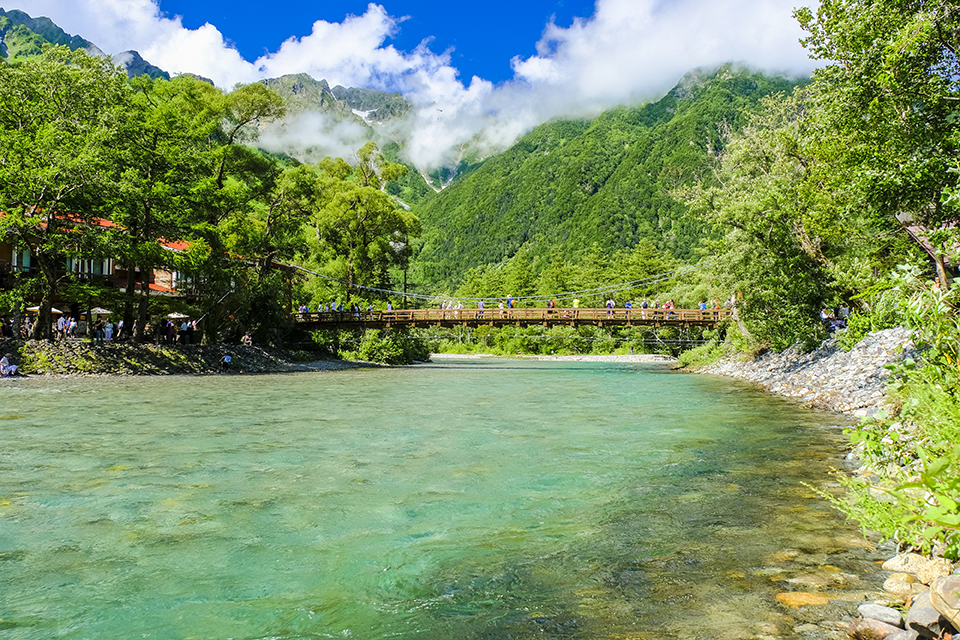
上高地(イメージ)
Majestic mountains and the Azusa River, forest and marshland, summer flowers — the further you walk in Kamikochi in summer, the more of its nature you meet. Even on a day trip, if you settle your route and the trail you want to walk beforehand, you can see plenty of what makes Kamikochi special. You can of course plan the whole itinerary yourself, and if you would rather keep the transport arrangements and connections as simple as possible, a day-trip tour is another way to do it. Head for Kamikochi this summer in whichever style suits you.
案内・監修
多田 空太(ただ そらた)
一般社団法人松本市アルプス山岳郷 所属
上高地をはじめ松本市西部エリアのコンテンツ造成と、地域のランドオペレーション体制の構築を担当。国内外の旅行者を現地で受け入れる立場から、上高地の交通事情や季節ごとの見どころに詳しい。
上高地おすすめスポットは、明神池近くにある「嘉門次小屋」の囲炉裏で焼き上げる岩魚の塩焼き。
「上高地に来ると、日本の自然の美しさを一番感じてもらえると思います。空気が本当にきれいで、歩いているだけで気持ちがリセットされます。」
*This article was produced on Jul. 30–31, 2026, under the guidance of Mr. Tada.
Club Tourism official LINE, WhatsApp, Facebook, Instagram
Follow us to get tips for traveling in Japan




-
The content is current as of the time of publication. Please check the official website for the latest information.
 Related articles
[Interview with Local Tourism Group Staff] Kamikochi Complete Guide to Solo Travel | Must-see spots, access, and clothing tips even for first-timers
Kamikochi surrounded by majestic mountains and the pure Azusa River. It's one of the mountain resorts where you can easily enjoy a walk, and you don't have to climb...
Nagano Cherry Blossom Guide | Ueda Castle & Garyu Park│ Club Tourism
Nagano Prefecture is a naturally rich area surrounded by Japan's three major mountain ranges, and is home to many of Japan's most famous cherry blossom viewing spots.
From sweets to miscellaneous goods! 15 souvenirs from Nagano
Nagano is famous for tourist spots such as Karuizawa, and it is famous for producing beautiful produce such as buckwheat noodles, wasabi, apples, and Nozawana (greens), taking advantage of the clean water.
30 Famous Peaks of the Japanese Alps ~ spectacular views ・Mountain trip to alpine plants and mountain hut gourmet ~
The Japanese Alps include the Hida Mountains (Northern Alps), which mainly span Toyama, Gifu, and Nagano prefectures and also extend into Niigata prefecture, and the Kiso Mountains in Nagano prefecture (...
Search by area
Domestic
Search by keyword
- Solo Travel
- Girls' trip
- family trip
- Couple's trip
- Goshuin (temple stamp)
- history
- Shrines and temples
- Pilgrimage
- art
- music
- famous castle
- Spectacular views
- world heritage
- Entertainment
- Gourmet
- hot spring
- island trip
- Cycling and skiing
- Festival
- History and Roads
- souvenir
- museum
- power spot
- Night view
- Railway
- Mountain climbing and hiking