Tateyama Kurobe Alpine Route Autumn Leaves Guide | Best Time, Weather, What to Wear & Access
Updated: May 28, 2026
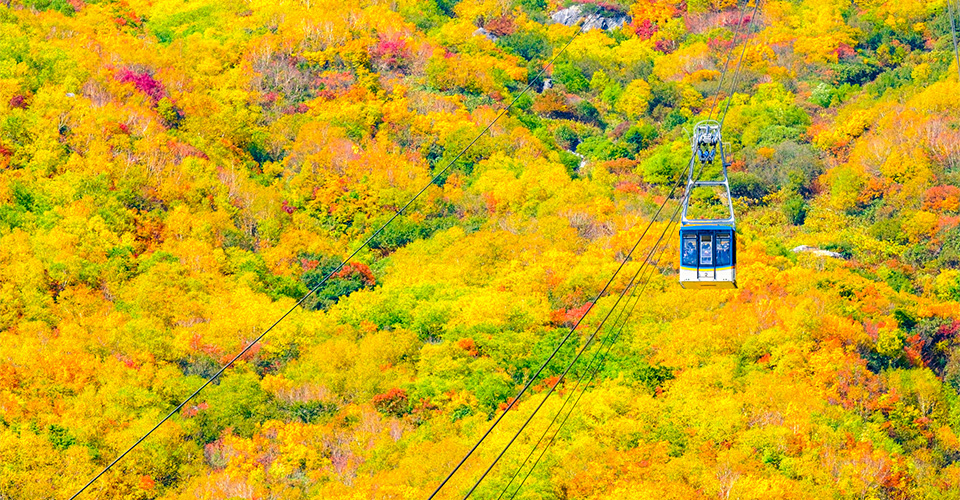
紅葉の立山ロープウェイ(イメージ)
立山黒部アルペンルートの紅葉は9月から10月にかけて、カラフルな大自然のビジュアルが気軽に楽しめるため大変人気があります。 弥陀ヶ原の黄金色に染まる草紅葉や立山ロープウェイから望む一面の紅葉、みくりが池に映る室堂の景色など、まさに秋の絶景を楽しめるスポット。10月には、運が良ければ紅葉と雪の競演が見られることもあります。 しかし、山の天気は変わりやすく、せっかくの紅葉が楽しめなくなる可能性も。しっかり情報を確かめて立山黒部アルペンルートの紅葉を楽しみましょう。
*This article was created for travelers planning to visit Japan, but readers in Japan may also find it useful.

-
Why Autumn Leaves on the Tateyama Kurobe Alpine Route Are Special
-
Best Time to See Tateyama Kurobe's Autumn Leaves: The Foliage Front by Area
-
October Only! A Rare View of Autumn Leaves and First Snow Together
-
Temperature and Clothing Guide for the Autumn Leaf Season
-
Tateyama Kurobe Alpine Route: Top Autumn Leaf Spots
-
Getting to Tateyama Kurobe
-
The travel pros handle everything, so all you have to do is "enjoy" Tateyama Kurobe.
-
FAQ
-
Summary
Why Autumn Leaves on the Tateyama Kurobe Alpine Route Are Special
The Tateyama Kurobe Alpine Route is one of the first places in Japan where autumn leaves can be seen. What makes it so special is the dramatic 1,975 m difference in elevation from the summit to the foothills, which lets you enjoy the autumn leaves over a long season as the colors move down the mountain. Another one-of-a-kind appeal is that you can follow the foliage front simply by changing from one mode of transport to the next. On top of that, sightseeing is relatively relaxed compared with the Snow Wall season, so you can take in the spectacular views while avoiding crowds—a feature unique to the autumn leaf season.
Best Time to See Tateyama Kurobe's Autumn Leaves: The Foliage Front by Area
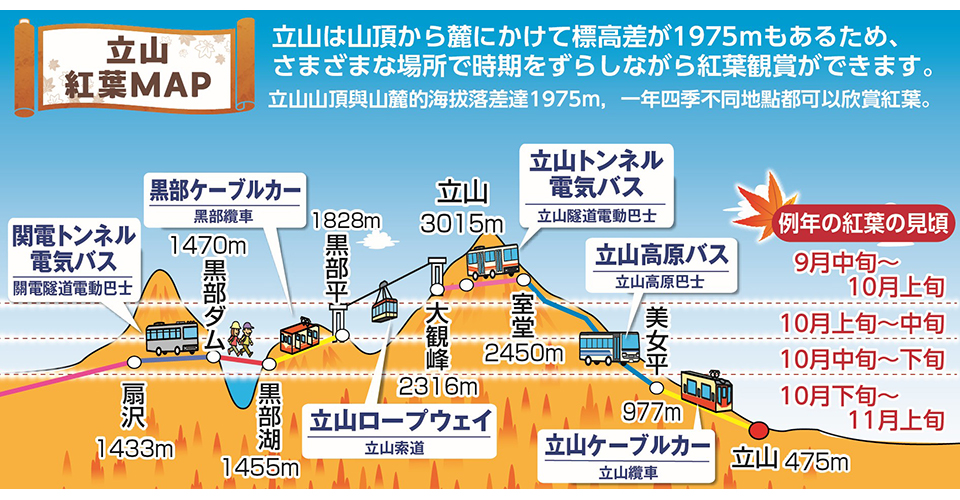
立山黒部アルペンルート 紅葉マップ(イメージ)
Autumn leaves on the Tateyama Kurobe Alpine Route begin at high-altitude Murododaira and work their way down to the foothills over about a month. This means that from late September to mid-October, you'll see the leaves at a different stage depending on when you visit—the route's biggest draw. Before planning your trip, first check which area will be at its best when you go. Note that peak times can shift by one to two weeks depending on the year. Before your visit, check the latest autumn leaf information on the official Tateyama Kurobe Alpine Route website or other sources.
October Only! A Rare View of Autumn Leaves and First Snow Together
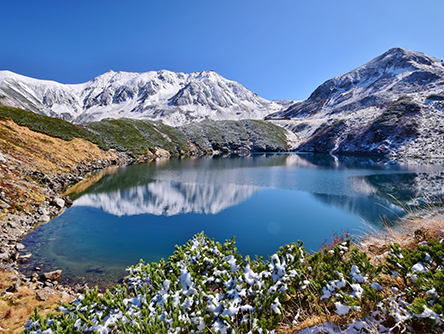
紅葉と雪のみくりが池(イメージ)
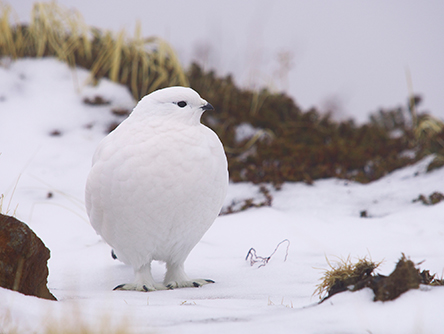
ライチョウ(イメージ)
At Murododaira, the first snow usually falls between early and mid-October. In recent years, first snowfalls have been recorded on dates such as October 5, 6, 17 and 27, turning the stone-paved walking paths into a pure-white snowscape overnight. Just after the first snow, a light dusting settles on the still-red Japanese rowan and the autumn-colored grasses of the wetlands, creating a remarkable contrast you can only see at this time of year. Once the snow begins, the rock ptarmigan—a symbol of Tateyama—also starts preparing for winter. If you're lucky, you may spot a ptarmigan changing into its white winter plumage amid the spectacular scenery.
(Information as of May 2026)
Temperature and Clothing Guide for the Autumn Leaf Season
Tateyama Kurobe Weather and Temperatures in October
During the autumn leaf season on the Tateyama Kurobe Alpine Route, temperatures drop to around 10°C, with winter-like cold and even the first snowfall.
At Murododaira, average 9 a.m. temperatures in September are 14.7°C (early), 14.4°C (mid) and 11.6°C (late); in October they are 9.6°C (early), 7.1°C (mid) and 3.7°C (late) (2021–2025, surveyed by Tateyama Kurobe Kanko Co., Ltd.).
October weather in Tateyama Kurobe is chilly, at around 10°C. From early to mid-October, snow can suddenly fall at places such as Murodo, at around 2,500 m above sea level. Conditions change not only in the morning and evening but also locally due to the terrain, and the weather often deteriorates quickly in the afternoon, bringing dense fog and thunderstorms. Be sure to check the weather forecast on the day.
Clothing and Packing List for the Autumn Leaf Season
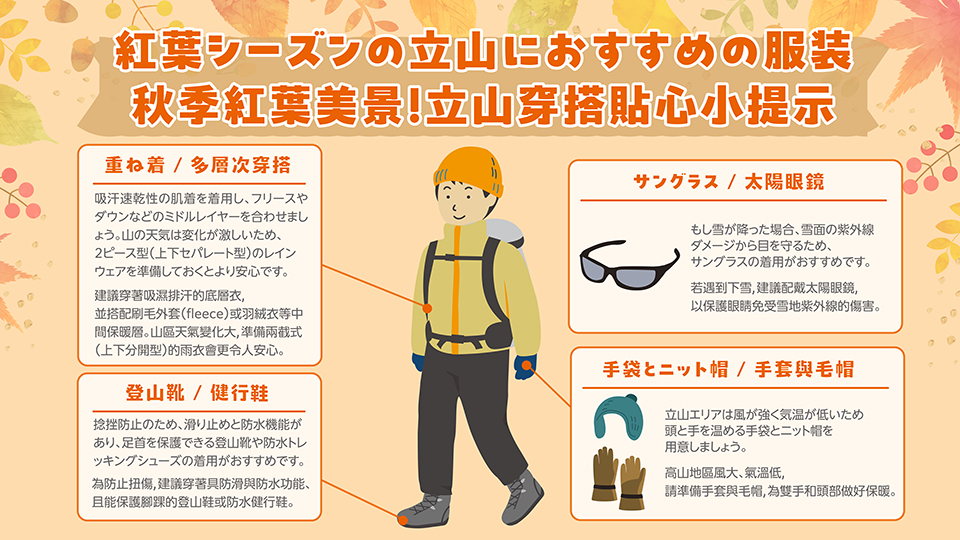
紅葉シーズンの立山におすすめの服装(イメージ)
Layering is key at this time of year. Start with a sweat-wicking, quick-drying base layer, add a mid-layer such as a light fleece or down jacket, and bring a two-piece Gore-Tex rain jacket and pants as an outer layer to protect you from rain, wind and snow.
To prevent sprained ankles, waterproof trekking shoes or hiking boots with ankle support, non-slip soles and waterproofing are recommended. If it's snowing, sunglasses to protect your eyes from UV rays are also a good idea.
Tateyama Kurobe Alpine Route: Top Autumn Leaf Spots
Murododaira (Best time to see the autumn leaves: mid- to late Sep.)
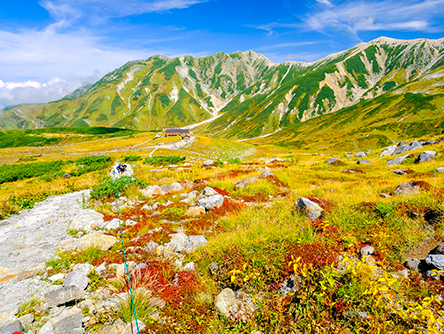
室堂平(イメージ)
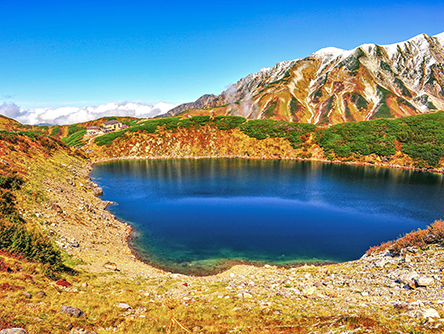
みくりが池(イメージ)
立山玉殿の湧水(イメージ)
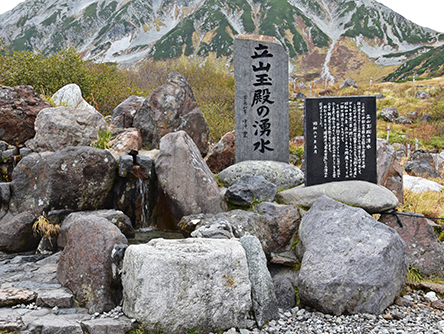
Murododaira sits at 2,450 m above sea level—the heart and highest point of the Tateyama Kurobe Alpine Route. The leaves usually start changing color in mid-September and peak in late September, and the beautiful autumn scenery lasts until early October. Surrounded by the three peaks of Tateyama, the slopes are carpeted down toward the foothills in the red of chinguruma, the yellow of iwaicho (deer cabbage) and the golden tones of autumn-colored grasses. The biggest highlight is Mikurigaike Pond, said to be the most beautiful volcanic lake in the Northern Alps. On calm days, it mirrors the Tateyama mountain range in its autumn colors, creating a mystical view. The contrast with the green of Kuril bamboo and Japanese stone pine is also striking, making this a truly photogenic autumn spot. Also be sure to stop by the Tateyama Tamadono Spring Water near Murodo Terminal. Shaped by lava that erupted some 50,000–60,000 years ago, this water carries the delicious taste of that vast stretch of time.
Midagahara (Best time to see the autumn leaves: late Sep. to early Oct.)
弥陀ヶ原(イメージ)
弥陀ヶ原(イメージ)
弥陀ヶ原(イメージ)
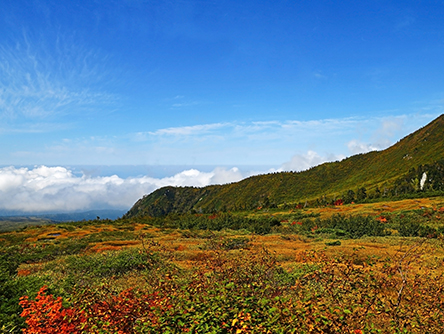
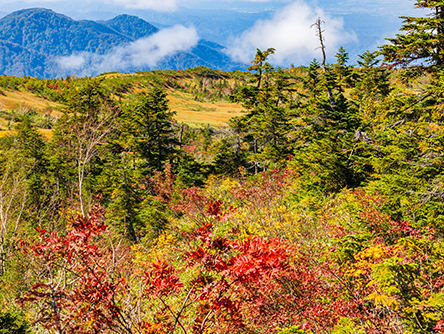
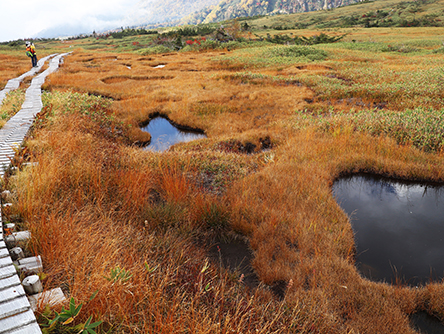
Midagahara reaches its peak for beautiful autumn leaves from late September to early October. Located at 1,600–2,000 m above sea level, this vast lava plateau was formed by volcanic activity about 100,000 years ago and is home to wetlands of international importance. From late September to early October, the wetlands turn yellow, orange and red with beautiful autumn-colored grasses (kusa-momiji), while the surrounding Erman's birch, Japanese rowan and mine-kaede maples also take on vivid colors. Along the boardwalk, countless small ponds known as "Gaki no Ta" (Hungry Ghosts' Rice Paddies) dot the landscape, and the contrast between the golden grasslands and blue water creates a dreamlike scene. If you're lucky, you may also see sights unique to this area, such as a mystical sea of clouds or the first snow dusting the colorful plants.
Daikanbo (Best time to see the autumn leaves: late Sep. to early Oct.)
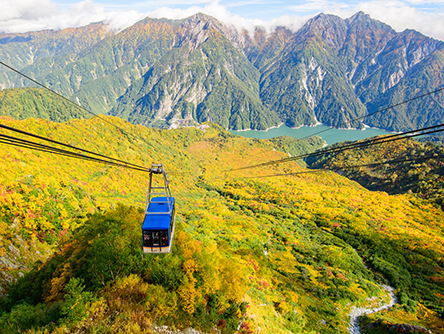
大観峰から見た立山ロープウェイ
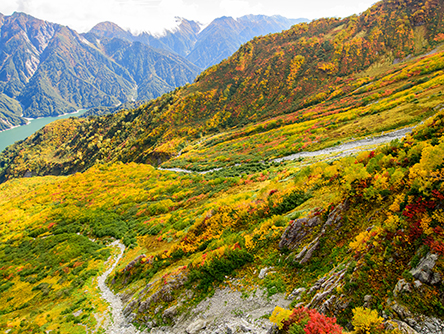
大観峰
Daikanbo is at its best for autumn leaves from late September to early October. You can take in the views on the Tateyama Ropeway, which connects Daikanbo and Kurobedaira.
With not a single support tower along the way, nothing blocks your view, and you can enjoy the 360-degree panorama below as if you were a bird in flight.
Especially stunning are the "three-tiered autumn colors"—white snow on the peaks, autumn leaves on the slopes and green at the foot—plus the shimmering green of Lake Kurobe. To make the most of the views, be sure to get a window spot when you board!
Kurobedaira & Lake Kurobe (Best time to see the autumn leaves: early to mid-Oct.)
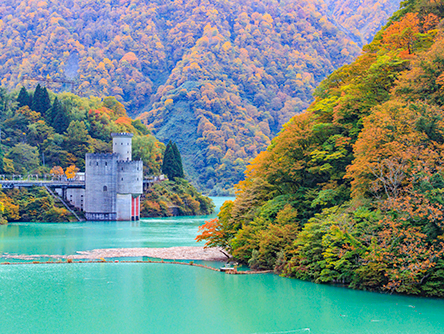
黒部湖(イメージ)
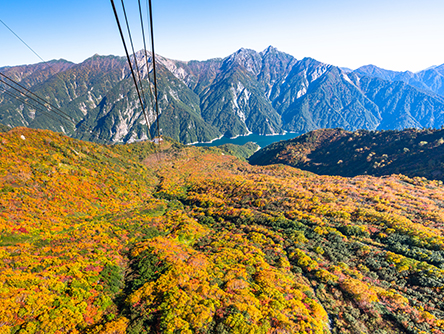
黒部平(イメージ)
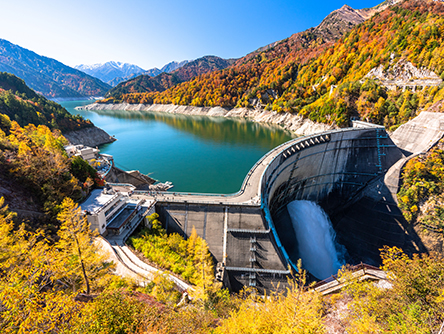
黒部ダム(イメージ)
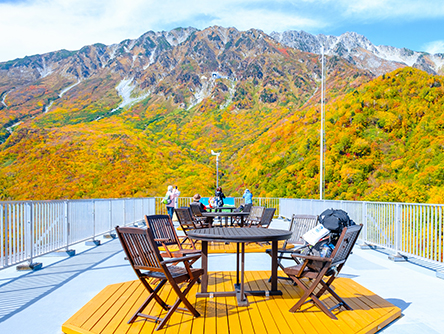
黒部平パノラマテラス(イメージ)
Kurobedaira and Lake Kurobe start to change color from early to mid-October. The two are linked by the Kurobe Cable Car, which climbs a steep slope with a gradient of up to 31 degrees and an elevation difference of about 400 m. Kurobedaira is home to Kurobedaira Garden, the Kurobedaira Panorama Terrace and an alpine plant garden, where you can enjoy autumn scenery of sweeping foliage, the dam and diverse alpine plants both up close and from afar. A must-see is the contrast between the red- and yellow-tinged mountains and the emerald green of Lake Kurobe, viewed from the Panorama Terrace on the station roof. The mountains seen across Kurobedaira Garden, right outside the station, are also beautiful, and at the alpine plant garden one level below, you can take your time observing about 100 species of alpine plants. Lake Kurobe, a huge man-made reservoir, has a well-maintained lakeside walking trail where you can enjoy autumn with all five senses—colorful mountain foliage, beautiful views of the lake, wild birds and a refreshing breeze.
Getting to Tateyama Kurobe
From Tokyo
●From Tokyo via the Toyama side
〈About 3.5 hours by public transport〉
Take the JR Hokuriku Shinkansen from JR Tokyo Station to JR Toyama Station, then transfer to the Toyama Chiho Railway and get off at Tateyama Station. From here, you can take the Tateyama Cable Car and cross the Tateyama Kurobe Alpine Route.
〈About 5 hours 10 minutes by car〉
From Nerima-Oizumi IC, take the Kan-Etsu, Joshin-etsu and Hokuriku Expressways and exit at Tateyama IC. On local roads, follow the "Tateyama National Park" signs for about 35 minutes and park at the Tateyama Station parking lot. Check parking availability in advance on the official Tateyama Kurobe Alpine Route website. From here, you can take the Tateyama Cable Car and cross the Tateyama Kurobe Alpine Route.
●From Tokyo via the Nagano (Ogizawa) side
〈Just under 4 hours by public transport〉
Take the JR Hokuriku Shinkansen from JR Tokyo Station to JR Nagano Station. Take an Alpico or Kita Alps Kotsu bus and get off at Ogizawa. Electric buses bound for Kurobe Dam on the Alpine Route depart from here.
〈Just under 4 hours by car〉
Take the Chuo and Nagano Expressways and exit at Azumino IC. On local roads, follow the signs for Omachi and Kurobe Dam for about 1 hour to reach the Ogizawa parking lot. Electric buses bound for Kurobe Dam on the Alpine Route depart from right nearby.
From Osaka
●From Osaka via the Toyama side
〈About 3 hours 50 minutes by public transport〉
Take the Limited Express Thunderbird to JR Tsuruga Station, transfer to the JR Hokuriku Shinkansen to JR Toyama Station, then change to the Toyama Chiho Railway and get off at Tateyama Station. Board the Tateyama Cable Car, the starting point, to enter the Tateyama Kurobe Alpine Route.
〈About 3 hours 25 minutes by car〉
From Maibara JCT on the Meishin Expressway, take the Hokuriku Expressway and exit at Toyama IC, then follow the "Tateyama National Park" signs on local roads for about 40 minutes to reach the Tateyama Station parking lot. Check parking availability in advance on the official Tateyama Kurobe Alpine Route website. From here, you can take the Tateyama Cable Car to enter the Tateyama Kurobe Alpine Route.
●From Osaka via the Nagano (Ogizawa) side
〈About 4 hours 40 minutes by public transport〉
First take the JR Tokaido Shinkansen to Nagoya Station, change to the Limited Express Shinano to JR Matsumoto Station, then transfer to the JR Oito Line and get off at Shinano-Omachi Station. Take an Alpico or Kita Alps Kotsu bus and get off at Ogizawa.
〈About 5.5 hours by car〉
Take the Meishin and Tomei Expressways to Komaki JCT, then the Chuo Expressway to Okaya JCT and the Nagano Expressway, and exit at Azumino IC. On local roads, follow the signs for Omachi and Kurobe Dam for about 1 hour to reach the Ogizawa parking lot. Electric buses bound for Kurobe Dam on the Alpine Route depart from right nearby.
From Nagoya
●From Nagoya via the Toyama side
〈About 3 hours 40 minutes by public transport〉
From Nagoya Station, take the JR Tokaido Shinkansen / Limited Express Shirasagi via Tsuruga Station, then the JR Hokuriku Shinkansen to JR Toyama Station, where you transfer to the Toyama Chiho Railway and get off at Tateyama Station. Board the Tateyama Cable Car, the starting point, and cross the Tateyama Kurobe Alpine Route.
〈A little over 4 hours by car〉
From Komaki on the Tomei Expressway, head to Ichinomiya JCT on the Meishin Expressway. Continue via Oyabe-Tonami JCT on the Tokai-Hokuriku Expressway to the Hokuriku Expressway, exit at Toyama IC, and follow the "Tateyama National Park" signs on local roads for about 40 minutes to park at the Tateyama Station parking lot. Check parking availability on the official Tateyama Kurobe Alpine Route website. From here, you can take the Tateyama Cable Car and cross the Tateyama Kurobe Alpine Route.
●From Nagoya via the Nagano (Ogizawa) side
〈About 3 hours 40 minutes by public transport〉
Take the Limited Express Shinano to JR Matsumoto Station, transfer to the JR Oito Line and get off at Shinano-Omachi Station. Take an Alpico or Kita Alps Kotsu bus and get off at Ogizawa. Electric buses bound for Kurobe Dam on the Alpine Route depart from here.
〈About 3.5 hours by car〉
Take the Tomei Expressway to Komaki JCT, then the Chuo Expressway via Okaya JCT and the Nagano Expressway, and exit at Azumino IC. On local roads, follow the signs for Omachi and Kurobe Dam for about 1 hour to reach the Ogizawa parking lot. Electric buses bound for Kurobe Dam on the Alpine Route depart from right nearby.
Toyama Side or Nagano (Ogizawa) Side: Which Entrance Is Best?
The Tateyama Kurobe Alpine Route has two starting points: Tateyama Station on the Toyama side and Ogizawa Station on the Nagano side. Choose the one that suits your travel plans.
●Tateyama Station (Toyama side)
From Tateyama Station, it takes just under 2 hours and 4 transfers between cable cars, buses, ropeways and more to reach Kurobe Dam Station. The round-trip fare is over 15,000 yen, but this route is recommended if you want to ride a variety of vehicles across the Alpine Route and fully enjoy the autumn leaves along the whole route.
●Ogizawa Station (Nagano side)
From Ogizawa Station, the Kanden Tunnel Electric Bus takes about 16 minutes to reach Kurobe Dam Station. You can also walk to Kurobeko Station on the Kurobe Cable Car, the starting point for autumn leaf viewing. With a direct ride and no transfers, the round-trip fare is a reasonable 3,200 yen. This route is recommended if you want to see the autumn leaves at a specific spot, or for families who want to keep costs down. Omachi Onsen-kyo is also at the Ogizawa end, so you can combine a hot spring bath with autumn leaf viewing.
The travel pros handle everything, so all you have to do is "enjoy" Tateyama Kurobe.
Tour Benefit ①: Leave All Six Transfers to Us
The Tateyama Kurobe Alpine Route has as many as six types of transport: electric buses, cable cars, highland buses, ropeways… Each has a different boarding point and limited operating times. On an independent trip, you have to handle everything yourself, from buying tickets to finding boarding points and managing transfer times.
On a Club Tourism tour, all of that is already arranged. No more worrying about "Where do I go next?" or "How long do I wait?"—you can focus on the scenery. Guests who joined our tours have told us, "立山黑部六種交通時間配合非常好" (the timing of all six modes of transport was perfect) and "在室堂有充足時間給我們遊覽拍照" (we had plenty of time at Murodo to explore and take photos).
Tour Benefit ②: No Japanese? No Problem
Announcements and signs on the Tateyama Kurobe Alpine Route are mainly in Japanese. Getting around during the busy season while gathering information on your own isn't easy, even for Japanese speakers.
Club Tourism tours are designed with international guests in mind, with supplementary explanations in English and Chinese and communication using translation tools. Participants have told us, "We didn't speak any Japanese but she explained everything to us in great detail" and "也會盡量用英文解說照顧不懂日文的人" (she explained things in English for those who don't understand Japanese). You can focus on your trip without worrying about the language barrier.
Tour Benefit ③: Reach Hard-to-Visit Places at a Fair Price
"I was able to visit a place that's hard to book on my own, at an affordable price"—this is a comment actually left by a participant. Tateyama Kurobe is very popular, and transport tickets during the autumn leaf season can be hard to get when arranging them yourself. On a tour, your seats are secured in advance, so you can travel with peace of mind. Several guests have also told us "性價比高" (great value for money)—another strength only a tour can offer.
FAQ
About the Tour
Q: Can children and seniors participate?
A: Yes. People of all ages can participate. Since you travel by bus during the tour, you won't walk for long. We warmly welcome children and seniors to join us.
About Meeting and Departure
Q: After booking, how can I check the meeting point and time?
A: After booking, you can check "Meeting point," "meeting time," and "emergency contact" on My Page. Before departure, you can also view "travel booklet Travel Guide" online.
About luggage
Q: Can I bring my suitcase to participate?
A: If you are traveling by bus, we have space for luggage, so you can bring your suitcase. However, please limit yourself to two large suitcases per person.
Language support
Q: Can I participate even if I don't speak Japanese?
A: Yes, you can. The tour is operated in Japanese, but important information is available in English and Chinese (Traditional) using AI translation equipment and written information. A tour conductors and drivers also use translation apps, so there is no need to worry about the language.
About payment
Q: What is the payment method? What is the currency?
A: Payment is made online in Japanese yen (credit card). The exchange rate is subject to the rules of the credit card company. Instant payment is required at the time of booking.
About local support
Q: Do you have physical stores in Taiwan or overseas?
A: In Taiwan, KNT Taiwan is the sole distributor of Club Tourism. For on-site consultations, please contact KNT Taiwan.
Passengers in Taiwan, please contact "Taiwan General Agent, Taiwan Kansai International Travel Agency" to register.
Online Registration https://www.knt-taiwan.com/contact.php
Call to register 02-87717551 (Mon~Fri 09:15~18:00 (excluding holidays))
Email info@knt-taiwan.com
Summary
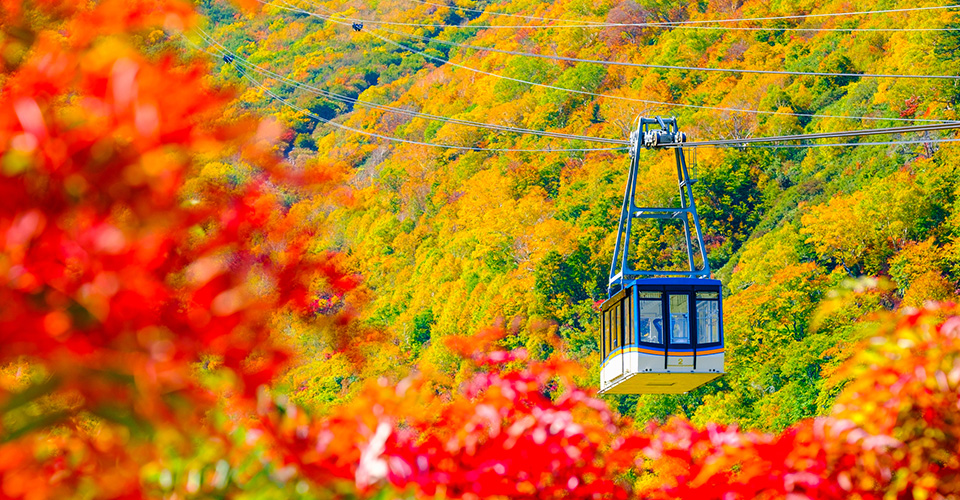
立山ロープウェイ(イメージ)
The greatest appeal of the Tateyama Kurobe Alpine Route is the chance to enjoy autumn leaves on a grand scale amid magnificent nature. October in particular is a special time, when white snow on the peaks and vivid leaves on the slopes create the "three-tiered autumn colors" and other remarkable sights. The autumn leaf season is relatively relaxed compared with the Snow Wall season, but popular areas can still get crowded. Make the most of a tour that takes care of everything from tickets to transfers, and set off on a comfortable journey through spectacular autumn scenery.
Club Tourism official LINE, Facebook and Instagram
Follow us to get tips for traveling in Japan



-
The content is current as of the time of publication. Please check the official website for the latest information.
 Related articles
Beautiful Nature That Changes with the Seasons! The Appeal of the Tateyama Kurobe Alpine Route
The Tateyama Kurobe Alpine Route is a mountain sightseeing route where you can take in the magnificent nature of the Northern Alps with all your senses. Cable cars, ropeways…
Enjoy the stunning views and delicious food! 11 recommended sightseeing spots in Toyama
With the opening of the Hokuriku Shinkansen, it has become even easier to visit Toyama Prefecture. There are many attractions such as Tateyama Kurobe Alpine Route and Owara Kaze no…
Including the delicious conveyor belt sushi! 12 Kanazawa gourmet staples
"Kanazawa Maimon Sushi" carefully selects delicious seasonal fish, chooses its rice and seasonings, and employs skilled chefs to prepare the sushi. Fresh ingredients are delivered directly from the port…
30 popular tourist areas in Kanazawa, featuring history and gourmet food!
Kanazawa is a city where time shakes every time you step down the path. The magnificent stone walls of Kanazawa Castle, the elegant scenery of the Kenrokuen Garden greenery, and...
Search by area
Domestic
Search by keyword
- Solo Travel
- Girls' trip
- family trip
- Couple's trip
- Goshuin (temple stamp)
- history
- Shrines and temples
- Pilgrimage
- art
- music
- famous castle
- Spectacular views
- world heritage
- Entertainment
- Gourmet
- hot spring
- island trip
- Cycling and skiing
- Festival
- History and Roads
- souvenir
- museum
- power spot
- Night view
- Railway
- Mountain climbing and hiking