Tour/Travel to the Zenkoji Temple main image exhibition
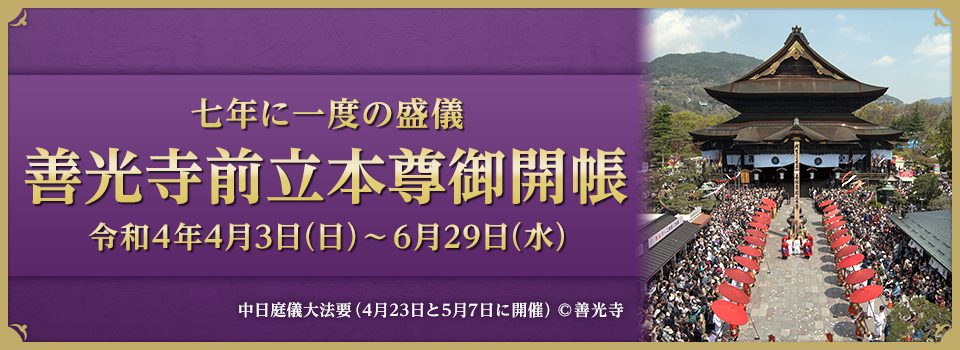
Club Tourism 's Zenkoji Temple Zenritsu Honzon Opening Tour/Travel Special! The Zenkoji Temple's largest ceremony, held once every seven years, will see the Zenritsu Honzon Opening. Don't miss this opportunity to visit. With a tour guide, you'll be well supported! It's easy to search for and book tours.
Sales on this special page have ended.
We will inform you as soon as it is ready.
What is the public display of the principal image of Zenkoji Temple?
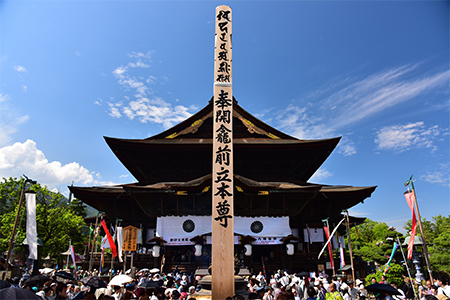
本堂と回向柱(イメージ)©善光寺
※回向柱は、混雑時、触れられない場合があります。
約1400年の歴史を持つ善光寺の本堂に安置されている本尊「一光三尊阿弥陀如来像」は白雉5年(654)以来の絶対秘仏として、直接お姿を拝することが出来ません。その御身代わりとして、鎌倉時代に「前立本尊」が造られました。普段は御宝庫に安置されていますが、七年に一度だけ、本尊にお迎えして特別にお姿を拝むことが出来ます。
現在の本堂建立(1707年)の際、松代藩が普代奉行にあたったというご縁から、「回向柱(えこうばしら)」が寄進され、本堂前に立てられます。回向柱は、「前立本尊」の右手の中指と“善の綱”で結ばれ、柱に触れる人々に“御仏“のお慈悲を伝えてくれます。
※回向柱は、混雑時、触れられない場合があります。
Main Events
What are morning and evening services?
The morning service of chanting sutras in the main hall is called O-Asaji. The Yuza-Hoyo is a memorial service that marks the end of the day and is held every evening only during the period of the Gokaicho. During the Gokaicho period, the shrine of the Zentatsu Honzon is opened every morning at O-Asaji and closed at the Yuza-Hoyo.
What is Goinmonchodai?
It is said that by receiving the three-size treasure seal "Goinmon," which is said to be an incarnation of the Gohonzon, on your head, you are guaranteed to go to paradise.
What is "juzuchodai"?
Before and after morning and evening services, as the head priest goes to and from the main hall, it is customary to have his head stroked with prayer beads in order to pray for good health.
*This may not be possible due to various circumstances.
What is the simultaneous public unveiling of the six Zenkoji temples?
The Buddha, which is said to have miraculous powers and is usually kept secret, is revealed by opening the doors of the shrine, and this ceremony is called Gokaicho.
In 2022, to coincide with the Shinshu Zenkoji Temple, Zenkoji Temple (Kai Zenkoji Temple) in Kofu City, Yamanashi Prefecture, Zenkoji Temple (Motozenkoji Temple) in Iida City, Nagano Prefecture, Zenkoji Temple (Sobue Zenkoji Tokai Betsuin) in Inazawa City, Aichi Prefecture, Zenkoji Temple (Seki Zenkoji Temple) in Seki City, Gifu Prefecture, and Zenkoji Temple (Gifu Zenkoji Temple) in Gifu City, Gifu Prefecture were all simultaneously opened to the public.
Other information about Zenkoji Temple
Kai Zenkoji Temple
It is said to be the public memorial site of the famous general Takeda Shingen, and is also the site of Honda Zenko's funeral, built by Shinshu Zenkoji Temple. Two giant dragons are painted on the ceiling of the inner sanctuary of the main hall, but this part is a suspended ceiling, and it is famous for the "roaring dragon" phenomenon that occurs when you clap your hands here, due to multiple reverberations.
Former Zenkoji Temple
The principal image of Shinshu Zenkoji Temple was abandoned in Horie, Namba during the anti-Buddhist/pro-Buddhist debate, but it was brought back by Honda Zenko, who was born in what is now Iida City, and is said to have been enshrined at Shinshu Zenkoji Temple. Honda Zenko enshrined the Buddha he brought back on a wooden mortar, and Motozenkoji Temple was built on this spot, and this wooden mortar is displayed as a sacred treasure in the treasure hall.
Seki Zenkoji Temple
Seki Zenkoji Temple, decorated with cherry blossoms in spring, is famous for Japan's only swastika-shaped ordination platform tour. It is said that this ordination platform tour was created as a training ground for monks in ancient times, and it is said that by following the dark path, people can purify their mind and body and be guaranteed to go to paradise.
Gifu Zenkoji Temple
Gifu Zenkoji Temple was founded when Oda Nobunaga moved the principal image of the temple, which had been moved from Shinshu Zenkoji Temple to Kofu by Takeda Shingen, to Gifu. In Jul., the "Cucumber Seal" ceremony is held to pray for a safe summer and to ward off illness and dementia.
Sobue Zenkoji Temple Tokai Betsuin
At the end of the Meiji period, two lotus flowers bloomed from one stalk on the grounds of the present-day temple grounds, which used to be a lotus field, and this temple was built by inviting the Zenkoji Nyorai Buddha from the Zenkoji Temple in Shinshu. The ordination pilgrimage of Sobue Zenkoji Temple, where it is said that one can see the state of the Pure Land, is said to be the largest in Japan.